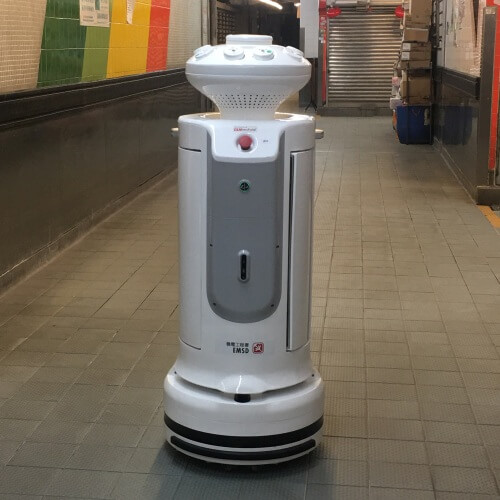
Robots for Indoor Disinfection (REF:C-0045)
E&M InnoPortal Trial Project Ref. No.:
Overview
Covid-19 has greatly increased public awareness of hygiene and the need for effective virus control. Studies have shown the contact with surface like door handles and lift buttons are largely contributed to the spread of diseases. Pressure was being put on having enough manpower for cleaning to keep the virus under control.
Robots for indoor disinfection have been developed to provide effective measures to control virus in indoor area such as general office areas, to protect the health of cleaners as well as to increase work and cost efficiency.
With the adaption of technologies including navigation algorithm, AI learning, LiDAR navigation, wireless and multi-sensor detection, these robots are able to perform a wide range of functions such as UV disinfection, chemical disinfection, vacuum, sweeping, spraying, disinfectant vaporization, PM2.5 and other air particles filtration and infrared body temperature detection across different environments based on operational needs.
Furthermore, the applications of Internet of Things (IoT) sensors, cameras and machine learning algorithms, allow accurate identification of disinfection environments and targets. The algorithms also come with automatic safety sensing that can generate site-clearing reminders, and report delayed work or emergency interruptions to user instantly.
| Problem Addressed | When pandemic hits, the availability of manpower to attend to work becomes a challenge. In comparison to human cleaning, disinfection robots provide more frequent and consistent solutions and can work even without supervision round the clock. Besides, these disinfection robots are equipped with different disinfection modules that can be tailored for specific disinfection requirements or purposes across different scenarios. |
|---|---|
| Innovation | Type 1 (P-0115): Intelligent UV Disinfection Robot Equipped with a navigation algorithm, the robot is able to carry out operation through mobile-phone Apps or network connected computer autonomously. The robot is an automated guided vehicle embedded with machine learning artificial intelligence, Simultaneous Localisation and Mapping (SLAM) and UV-C lamp disinfection module which allows autonomous operation. Type 2 (P-0104): Whiz, AI (Artificial Intelligent) enabled semi-autonomous vacuum cleaning robot The operating system is cloud-connected which enables up to 600 cleaning routes pre-programmed upon mapping. The robot is equipped with two PM2.5 HEPA filters enabling it to filter airborne particles for indoor air quality control. Type 3 (P-0112): Puductor Indoor Disinfection Robot The system incorporates RGBD sensor, LiDAR and visual positioning detection system to achieve 3D obstacle avoidance detection, autonomous navigation and high-performance atomization module for disinfection effect. Type 4 (P-0113): RM-D-FEC1 Disinfection Robot The subject robot has autonomous navigation function and is designed to carry out disinfection at designated areas through wireless and multi-sensor detection system. Type 5 (P-0114): CCLE-IC-2-65 Disinfection & Sweeping Robot The subject robot possesses navigation autonomous function, dual chemical disinfection and vacuum cleaning function. It is designed to perform space spraying and vacuum cleaning procedures automatically through wireless and multi-sensor protection system. Type 6 (P-0103): RM-D-FEC1 Disinfection Robot With its intelligent navigation function, the robot is able to perform disinfection procedure by mixing chemical disinfectant and water to form mist particles to carry out cleaning at designated areas autonomously. Type 7 (P-0102): iKoo-800-SIPA Disinfection & Sweeping Robot With the assistance of the navigation autonomous function, the system can perform dual chemical disinfection and vacuum cleaning functions. The space spraying and vacuum cleaning procedure can be carried out automatically through wireless and multi-sensor protection system. Type 8 (P-0101): Intelligent Sterilization Robot The robot is reportedly the first Autonomous Mobile Robot (AMR) that has integrated both UV-C light and disinfectant vaporization nozzles for efficient disinfection. It also comes with two PM2.5 HEPA air filtration modules which are intended to prevent the spread of airborne bacteria. Type 9 (P-0123): CCLE-PR-1-60H Cleaning and Disinfection Robot It combines capability of chemical disinfection and vacuum cleaning and can be operated autonomously by LiDAR navigation system. Type 10 (P-0124): ARIS-K2 Unmanned Antivirus Robot Combined capability of UV-C light disinfection and infrared body temperature detection, the robot can be operated autonomously by LiDAR navigation system. Type 11 (P-0137): UBTECH Epidemic Prevention Robot Aimbot With the combination of chemical disinfection and body temperature detection capability, the robot can be operated autonomously by Simultaneous Localisation and Mapping (SLAM) technology. |
| Key Benefits |
|
| Project Reference | Type 1: Type 2: Type 3: Type 4: Type 5: Type 6: Type 7: Type 8: Type 9: Type 10: Type 11: |
| Other Reference |
|