Refuse Bin Monitoring System (REF:C-0016)
E&M InnoPortal Trial Project Ref. No.:
Overview
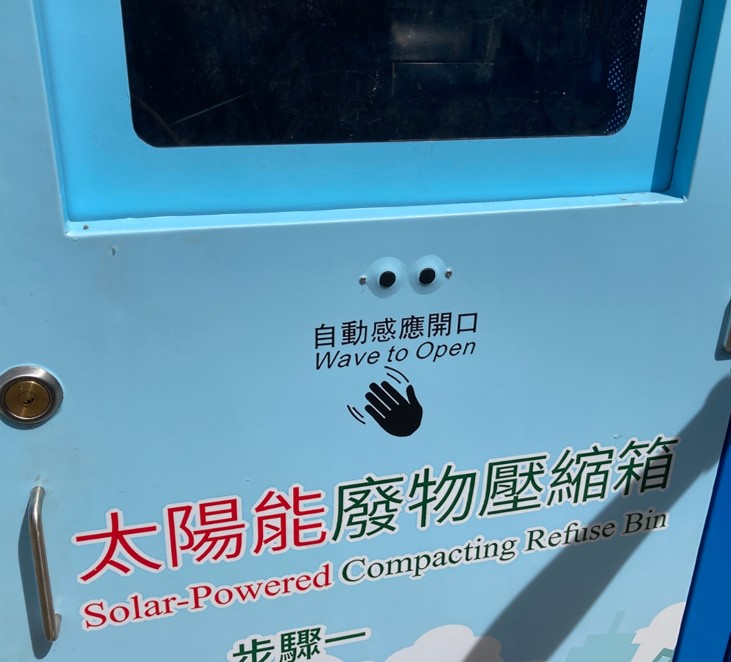
The Remote Monitoring System (RMS) for Compacting Refuse Bins (CRBs) involves the use of sensors, communication devices and data analysis tools to provide real-time information about the status and fill level of the bins so that waste management contractors can optimise their collection routes, ensuring that bins are emptied only when necessary to reduce unnecessary trips and associated costs.
| Problem Addressed | Since 2018, the Food and Environmental Hygiene Department (FEHD) has launched solar-powered CRBs to improve environmental hygiene and alleviate pest infestation arising from refuse accumulation. In order to obtain real-time data pertaining to the operation status of CRBs and the delivery of daily waste collection services to facilitate subsequent analysis on the uplift of management and services quality, an RMS has been developed through Government-Wide IoT Network (GWIN) leveraging Internet-of-Things (IoT) technology. |
|---|---|
| Innovation | The "Onsite IoT Data Gateway" with multiple data interfaces is used to capture all the necessary onsite data from CRBs, including "Bin Full Alarm", "Compressor On Signal" and "Door Open Signal". The collected data is then sent to the IoT Server (Cloud) through NBIoT, LoRaWAN, Wifi, 4G or 5G mobile network, then stored, processed and organised into alarms, line charts, reports and web interfaces. Real-time data is exported to GWIN, while alarms are sent to FEHD users and other stakeholders via emails or SMS. Users can access the website to view the line charts, the reports and the setting up of alarms for appropriate actions and long-term analysis of CRB performances. |
| Key Benefits |
|
| Project Reference | FEHD Compacting Refuse Bins |