Battery Monitoring System for PV Lights (REF:C-0011)
E&M InnoPortal Trial Project Ref. No.:
Overview
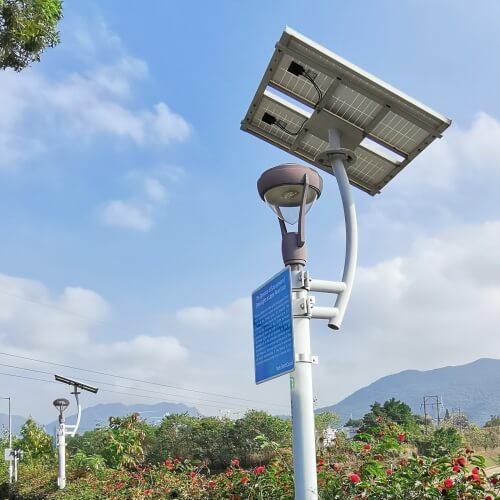
The Battery Monitoring System for PV Lights is a wireless Internet of Things (IoT) technology to provide remote monitoring information of solar LED lampposts and predict potential faults without the need for on-site inspection. It employs sensor boards installed in the lampposts equipped with a proprietary real-time battery state and health diagnostics system. The measured data includes battery voltage, lamp current, on-time duration and temperature within the power cabinet.
| Problem Addressed | The lamppost system consists of a solar charging controller and a timer to control battery charging and discharging as well as the on-off of the lampposts. However, the fluctuations in battery voltage will affect the operation of the timer, occasionally causing unintended activation of lamppost LED. Furthermore, the system cannot report faults to operators remotely, relying mainly on resident reports or regular on-site visual inspections. Therefore, faulty lampposts may not be identified and repaired in time, causing inconvenience to users. The Battery Monitoring System for PV Lights addresses the above problems by enabling real-time measurement and fault alarm. |
|---|---|
| Innovation | An online battery diagnostic device is developed for Uninterruptible Power Supply (UPS) system to perform real-time monitoring of battery state and health. A local data management system is also developed for collecting and transmitting battery information to the central control centre. The sensor modules comprise temperature sensors, current sensors, RF antennas, battery diagnostic modules and LoRa gateway. They receive information from the sensor boards and forward it to a cloud server for storage and data analysis. Users can remotely monitor these data and obtain basic analytical results through a web interface in PCs or mobile devices. |
| Key Benefits |
|
| Project Reference | Ng Tung River |