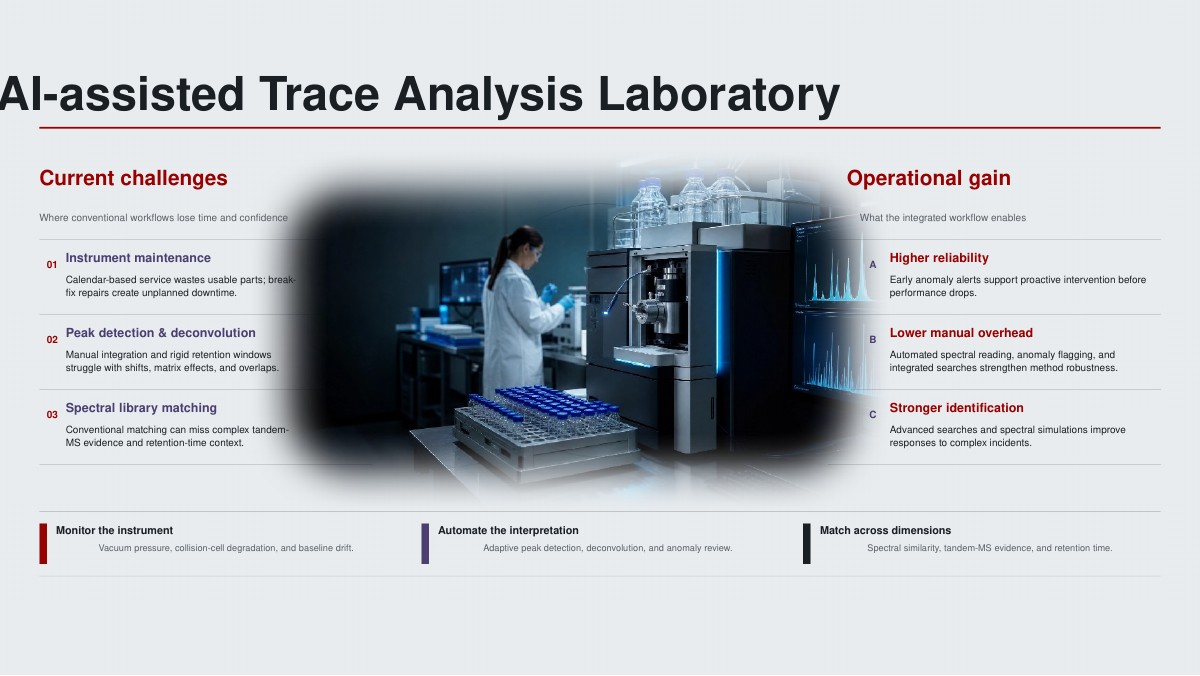
Trace analysis laboratory operations rely on three critical pillars: instrument stability, accurate peak detection and deconvolution, and reliable library matching. Current laboratory workflows face major bottlenecks in each area:
Instrument Maintenance: Existing strategies alternate between calendar-based preventive maintenance (wasting usable parts) and reactive break-fixes (causing costly downtime and expedited repairs).
Peak Detection & Deconvolution: Reliance on manual integration and rigid retention windows introduces human error and struggles with peak shifts, matrix effects, and overlaps, driving up labor overhead.
Spectral Library Matching: Conventional matching struggles with complex tandem mass spectrometry data and often omits retention times as an identifier, increasing the risk of misidentification.
Expected Outcome
Proactive Hardware Monitoring: Tracking hardware telemetry—such as vacuum pressure fluctuations, collision cell degradation, and baseline drifts—allows AI to alert technicians to subtle operational anomalies before performance drops below acceptable thresholds.
Automated Data Processing: The system independently reads analysis spectra, flags anomalies, and executes integrated library searches, significantly boosting method robustness while reducing manual overhead.
Enhanced Compound Identification: Advanced library searches and spectral simulations improve the accuracy of unknown compound identification, strengthening response capabilities for complex incidents.