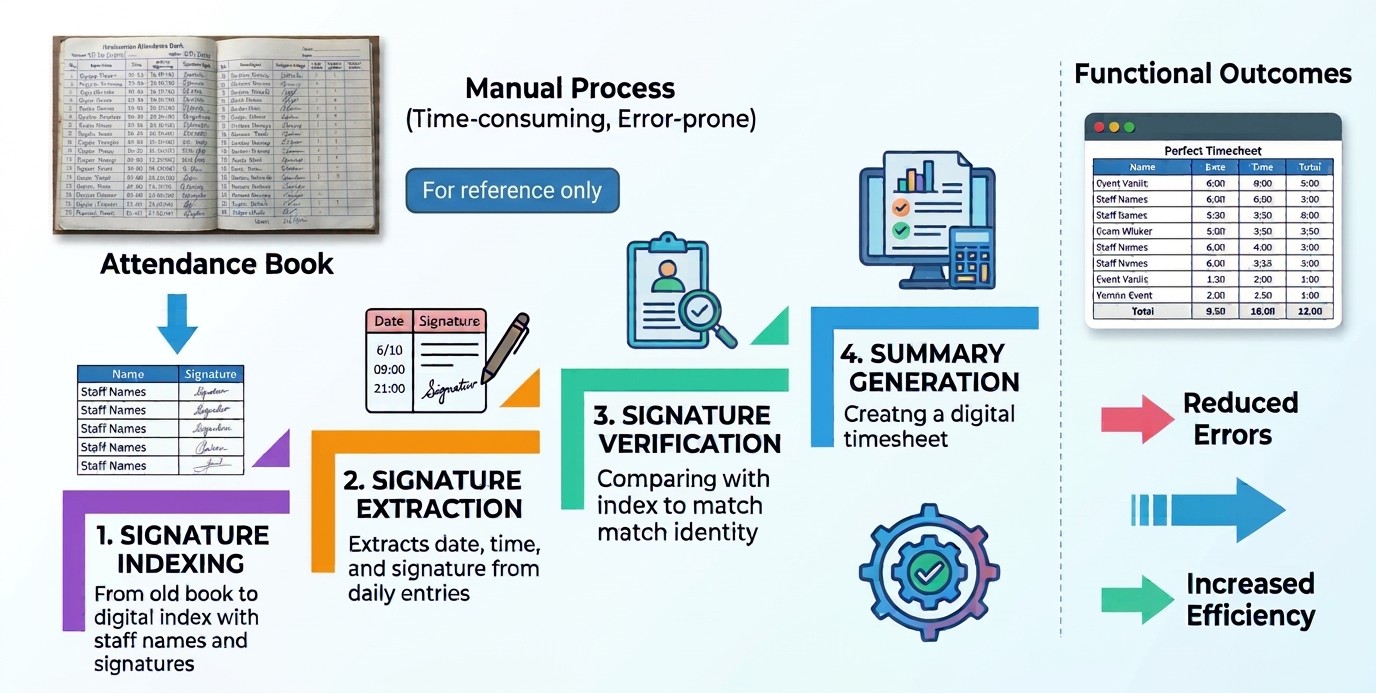
Attendance Book Signature Recognition & Timesheet Generation
I&T Wish
Attendance Book Signature Recognition & Timesheet Generation (REF: W-0621)
Matched I&T Solution
Trial Project
Summary and Challenges
Handwritten attendance books remain widely used across frontline operations, yet manually transcribing duty records and verifying signatures is time-consuming and error-prone. This project aims to digitize and automate the whole attendance-book process through image recognition, signature matching and reporting technology. The solution should be able to perform:
Signature indexing – From the attendance book, extract each staff member’s duty time, name and corresponding hand-written signature to build a signature index.
Signature extraction – From the attendance book, extract the signature, date and time of each attendance record.
Signature verification – Verify each extracted signature against the index to find the most similar matching identity.
Summary generation – Generate a summary table as a timesheet for each user.
Key challenges:
Hand-written signatures vary greatly in size, angle, pressure and style, making accurate recognition and matching difficult.
Attendance books often contain poor handwriting, noise, smudges, overlapping strokes and uneven lighting or scanning quality.
The extraction and verification steps must be robust to these variations while maintaining high accuracy and low false matches.
The final timesheet must be complete, accurate and consistent for payroll and attendance management.
Expected Outcome
Functional outcomes:
Build a signature index from each staff member’s duty time, name and hand-written signature in the attendance book.
Automatically extract the signature, date and time of each attendance record.
Verify each extracted signature against the index and identify the most similar staff member with high accuracy.
Automatically generate a complete, accurate timesheet summary for each user.
Reduce manual data entry, minimize transcription errors and improve attendance and payroll management efficiency.
Delivery format – reusable, programmable building blocks for downstream integration:
API Server – the four capabilities exposed as RESTful HTTP endpoints with structured JSON payloads.
Packages – installable packages (e.g. Python wheels) exposing the same capabilities as importable functions and classes.
MCP Servers – capabilities packaged as Model Context Protocol servers for AI assistants and LLM tools.
Common requirements – consistent input/output formats and comprehensive API documentation.
Resource efficiency – minimize CPU/GPU usage, favoring lightweight models that run on modest hardware.
XinChuang compatibility – compatibility with XinChuang hardware, chips and operating systems is a plus.
Expected Trial Duration
2-month
Contact Information
I&T Wish Proposer
:
Electrical and Mechanical Services Department (EMSD)